

Thank you!
The form has been successfully submitted
The form has been successfully submitted
Oops! Something went wrong, please try again

If you look at calls throughout the day, you can see that the same traffic produces different results. Yesterday – 60% connections, today – 48%. At the same time, the team has not changed, and the scripts remain the same.
Such fluctuations are usually not related to sales. They appear at a stage that is not visible in reports – how exactly the call reaches the recipient.
Some calls take longer to connect, some do not go through, and some are routed through less stable paths. In statistics, they appear as regular calls, but in reality, this is a difference in contact quality.
With several hundred calls per day, even a small variation in these processes creates a noticeable gap in results.
SIP Trunk is responsible for this exact stage. It determines how voice traffic is processed, how calls are distributed, and whether they reach the answer under real load.
Without control at this level, some calls are lost, even if the team and traffic remain unchanged.
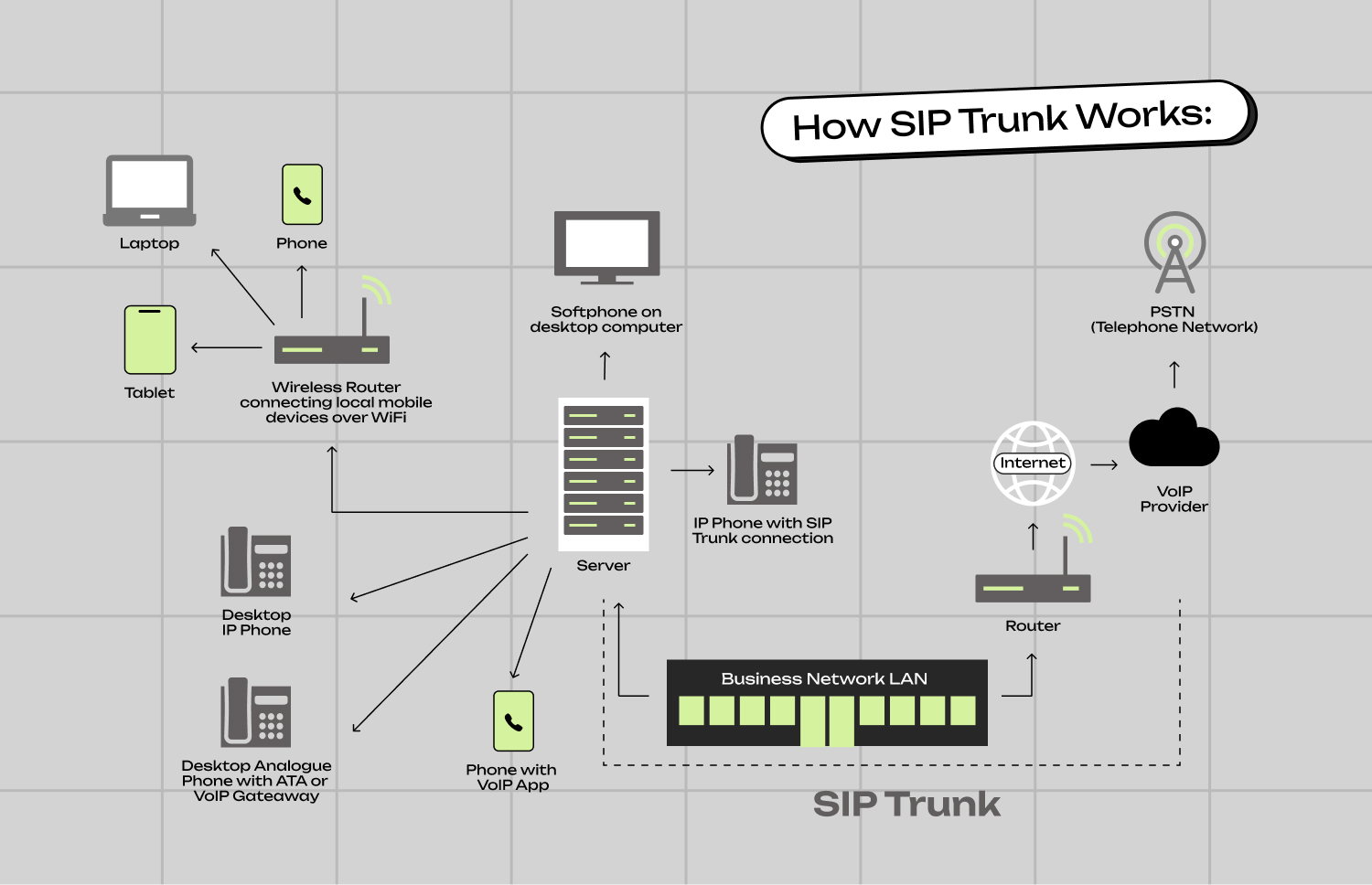
SIP Trunk connects a company’s telephony to external networks via IP. Each call does not go directly to the recipient but passes through several processing layers.
A typical path looks like this: A-number → transit routes → termination point → internal system.
At each of these stages, the result is formed:
This is where losses occur, which are not visible in CRM but affect ASR and conversion.
In traditional telephony, the number of simultaneous calls is limited by lines. If the load exceeds this limit, some calls do not get processed or are queued.
SIP Trunk removes this limitation. The number of channels adjusts to the current volume without replacing equipment or rebuilding the system.
At a load of 200–300 simultaneous calls, this becomes critical. Without scalability, part of the traffic is lost before contact, even if agents are available. With SIP Trunk, the system distributes calls and processes them in поток without accumulation.

The main difference appears in international calls. Voice transmission over IP allows bypassing traditional carrier tariffs.
Depending on the destination, savings range from 30–60%. With several thousand minutes per month, this has a noticeable impact on costs.
In addition, costs become transparent. There is a clear rate per destination and a predictable cost when traffic increases. This allows budgeting instead of reacting to invoices after the fact.
Call quality depends on how the call is routed, not only on internet quality.
Several metrics provide a real picture:
SIP Trunk allows control over these parameters through routing. Traffic is distributed across directions, and the system selects more stable routes.
In DID Global projects, this leads to an ASR increase of 10–15%, which at 500 calls per day means dozens of additional contacts without changing traffic volume.
A key element is failover. If one route fails or becomes overloaded, traffic automatically switches to another. Without this, some calls are lost during peak periods.
SIP Trunk connects to CRM, dialers, and analytics without additional solutions.
All calls are recorded automatically. Data is transferred into the system without manual input. Call distribution is built according to predefined logic.
This provides process control: it becomes clear who handles calls, how long interactions take, and where delays occur.
Telephony stops being a separate channel and becomes part of team operations.
SIP Trunk provides access to international destinations without physical presence.
It is possible to connect local numbers in different countries, run inbound and outbound calls, and test new GEOs without delays.
For companies working across multiple markets, this reduces launch time from days or weeks to hours.
As a result, new directions can be tested quickly without investing in separate infrastructure.

In one DID Global project, a client worked with outbound traffic in Europe at a volume of about 600 calls per day. At this load, ASR remained at 50–52%, meaning almost every second call did not turn into a conversation.
In reports, this looked like unstable conversion, but analysis showed a different picture. Part of the traffic went through overloaded routes, PDD exceeded 4–5 seconds, and the lack of backup channels did not allow the system to compensate. During peak hours, this resulted in an additional loss of 10–15% of total call volume.
After restructuring routing and implementing failover, the processing model changed. Traffic was distributed across multiple routes, and in case of overload, the system automatically switched to alternatives.
As a result, ASR increased to 64–67%. With the same volume, this meant an additional 80–100 connections per day. PDD stabilized at around 2–3 seconds, directly affecting the number of successful contacts.
With an average conversion rate of 5–7%, these additional connections resulted in 4–7 deals per day without changes in traffic, team, or scripts.
In this case, the result was achieved not by increasing call volume, but by ensuring that more calls reached actual conversations.
If, with increasing load, some calls do not reach conversations, the issue lies at the routing level.
DID Global can show what percentage of calls is lost and at which stage it happens.
Connection takes from a few hours to one day.
The key stage is load testing. It shows how the system behaves under real call volume.
Without this, it is impossible to assess routing quality.
If your call performance is unstable, start with infrastructure.
Submit a request, we will check routing, latency, and ASR in your system and show where contacts are being lost.