


Thank you!
The form has been successfully submitted
The form has been successfully submitted
Oops! Something went wrong, please try again

A call center operates under constant load. Calls arrive in waves, operators change their pace, and customers expect quick responses. In such an environment, telephony either supports the process or becomes a bottleneck.
That is why call centers increasingly rely on SIP Trunk, as a way to manage capacity and call quality in real time.
Connectivity issues rarely appear critical at first. They accumulate gradually: wait times increase, repeat inquiries become more frequent, and operators spend more time handling the same questions. As a result, service metrics decline and the cost of each interaction rises.
Call center traffic is never uniform. There are peak hours, quiet periods, seasonal spikes, or campaigns that cause a sudden surge in calls. The communication system must adapt to these changes without downtime or manual intervention from technical teams.
SIP Trunk allows the number of concurrent calls to scale exactly when needed. The call center gets the required capacity during peak hours without maintaining excess lines at all times. This reduces costs and removes technical limitations during traffic growth.

Voice quality is equally critical. For a call center, every poor-quality call means a longer conversation, a repeat contact, or a negative customer experience. A flexible SIP infrastructure with proper routing helps maintain stable call quality even under high traffic intensity.
SIP Trunk routes voice traffic over an IP network, eliminating rigid dependence on physical phone lines. Channels become a software-based resource that can be managed according to actual demand.
This allows a call center to scale without installing hardware, changing cabling, or going through lengthy coordination processes. Telephony begins to operate in the same rhythm as the business.
SIP Trunk supports a large number of simultaneous connections. During peak loads, calls are not blocked due to a lack of lines but are evenly distributed among operators.
This is especially important for customer support, hotlines, and high-volume campaigns.
For this reason, infrastructure providers that work with call centers, such as DID Global, focus not only on channel capacity but also on redundancy, route control, and voice traffic stability during peak periods.
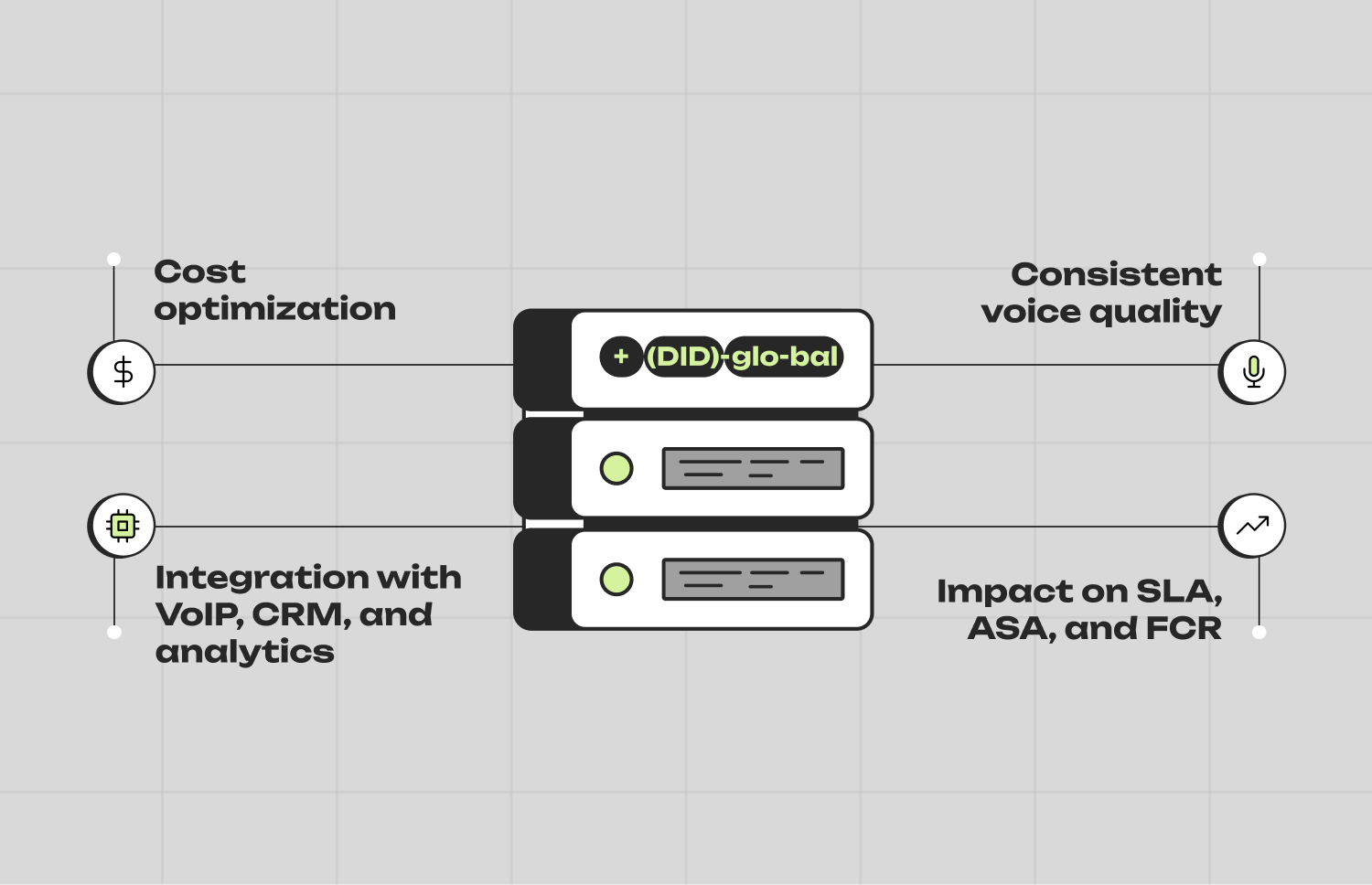
Technical solutions only have value when they reduce operational losses.
SIP Trunk enables payment based on actual channel usage. The need to maintain excess lines and pay for physical infrastructure disappears. Long-distance and international traffic also becomes more cost-effective thanks to IP routing.
This gives management clear visibility into real workloads, allows performance changes to be evaluated accurately, and supports data-driven decisions rather than assumptions.
The quality of telephony directly affects key call center metrics. When the system is stable, wait times decrease, the percentage of answered calls increases, and the share of inquiries resolved on the first contact grows.
SIP Trunk does not change processes on its own, but it creates the technical conditions that allow those processes to operate efficiently.

The starting point should not be choosing a pricing plan, but analyzing actual traffic and the scenarios in which the system must not fail. For a call center, this means clearly understanding:
Failure scenarios should be designed separately. What happens if one route becomes unavailable? Where are calls directed if the PBX is overloaded? Is there automatic failover without engineer intervention? These questions must be addressed before launch, not during an incident.
The second key stage is route quality and redundancy. A SIP Trunk provider must operate multiple routes, offer geographic redundancy, and be able to reroute traffic quickly during peak periods. For a call center, this is critical: even short quality drops immediately affect ASA, FCR, and customer satisfaction.
Real-time analytics are equally important. A call center must be able to see:
Without this data, SIP Trunk turns into a “black box,” where issues become visible only after customer complaints.
For a call center, SIP Trunk is part of the operational infrastructure that directly impacts service metrics, team stability, and the ability to scale without sacrificing quality.
That is why implementing SIP Trunk should be approached as an infrastructure project, not as a quick replacement of phone lines.