Thank you!
The form has been successfully submitted
The form has been successfully submitted
Oops! Something went wrong, please try again

Business has long stopped being tied to a single location.
But telephony has often remained in the past – tied to the office, cables, and a desk.
This is where the gap appears. The team moves, but communication does not.
In this gap, businesses lose calls, control, and money.
Mobility is about responsibility.
About whether a company can respond to a client regardless of where an employee is physically located.
Hybrid and remote work do not create problems by themselves.
Problems arise when communications fail to keep up with the operating model.
A client calls and gets no answer.
An employee responds from a personal number.
A manager sees only high-level metrics without understanding where the process broke down.
This is not a discipline issue. It is an infrastructure issue.
VoIP is often explained technically as “calls over the internet.”
For business, this definition means very little. It does not answer the key question: what actually changes in how the company is managed?
In reality, VoIP solves one fundamental problem.
It separates the company’s phone number from a specific location, device, or person.
When a number is tied to an office, the business depends on the office.
When a number is tied to a system, the business depends only on processes.
The number no longer “lives” on a desk, in an equipment cabinet, or on a specific phone.
It lives in the infrastructure. And that infrastructure is available wherever there is internet access.
This changes the management approach:
VoIP brings order to communications.
An employee can answer from a laptop, smartphone, or VoIP phone.
The client still sees the corporate number.
For the business, this means:
Mobility stops being chaotic. It becomes manageable.
One of the main mistakes is assuming that mobility requires simplicity.
In reality, it requires clear rules.
VoIP makes it possible to maintain:
The only difference is that people can be anywhere.
For a manager, the question of mobility has long gone beyond geography.
What matters is not where the team works, but whether it remains manageable.
In mobile and remote teams, control is often lost not because of people, but because there is no shared system. Calls are distributed chaotically, some responses come from personal numbers, and the overall picture consists only of fragments.
That is why the key questions for a manager are always the same:
VoIP brings all these answers together in one place.
It records every call, route, outcome, and response time, regardless of where an employee is physically located.
As a result, mobility stops being a risk area.
It becomes a working model where decisions are based on facts, not assumptions.
Without such a system, remote work looks like freedom. With it, it looks like a managed structure.
An app by itself solves nothing.
It only works when it is part of a system.
Real value appears when:
Otherwise, it is simply another phone.
A mobile call without data is only half the job done.
When VoIP is integrated with a CRM, the business gains not just the fact of a call, but its meaning.
Who called.
Why they called.
How it ended.
This saves time and reduces decisions made “by gut feeling.”
Mobility increases the number of access points.
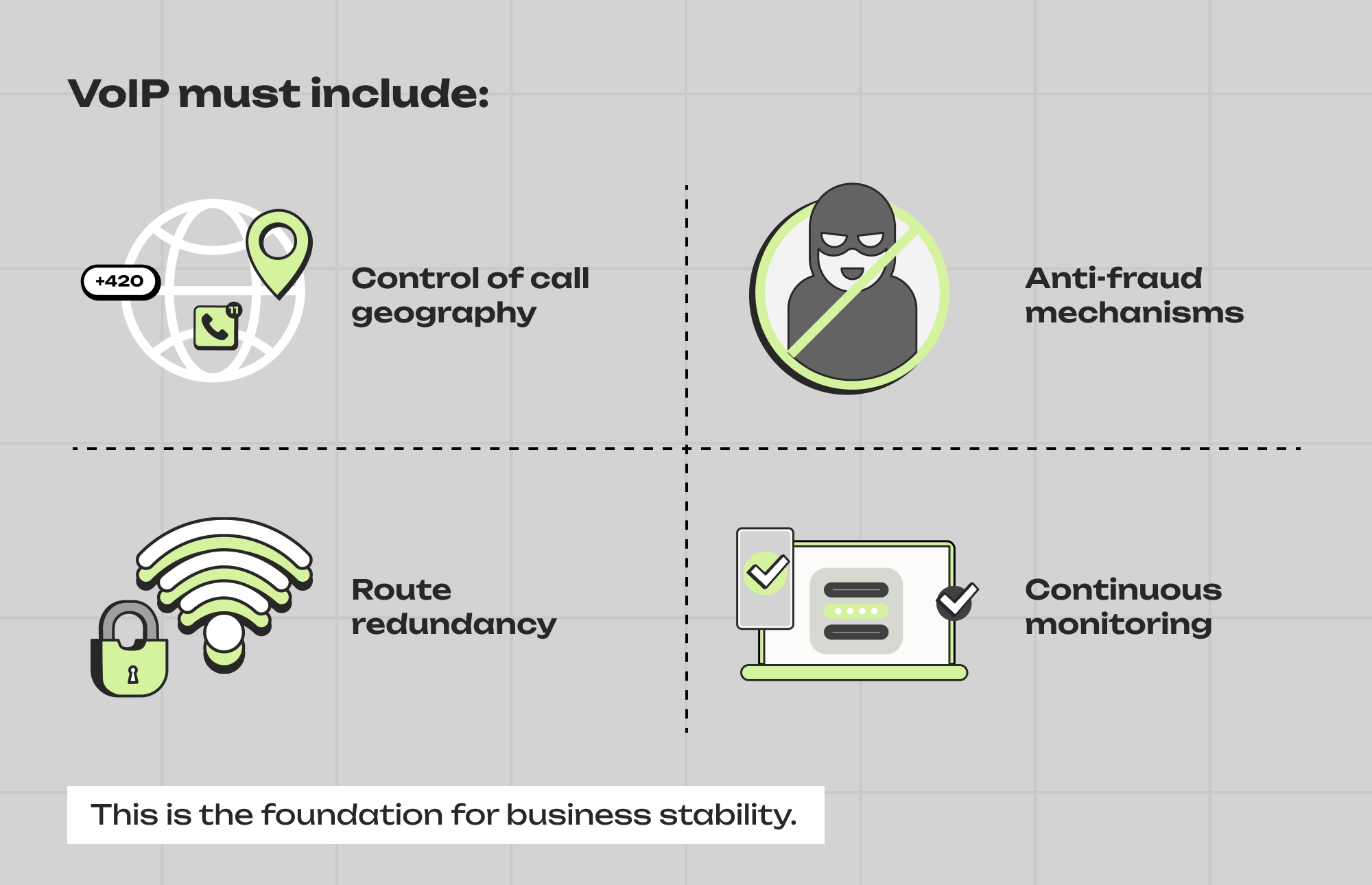
That is why VoIP must include:
This is the foundation for business stability.
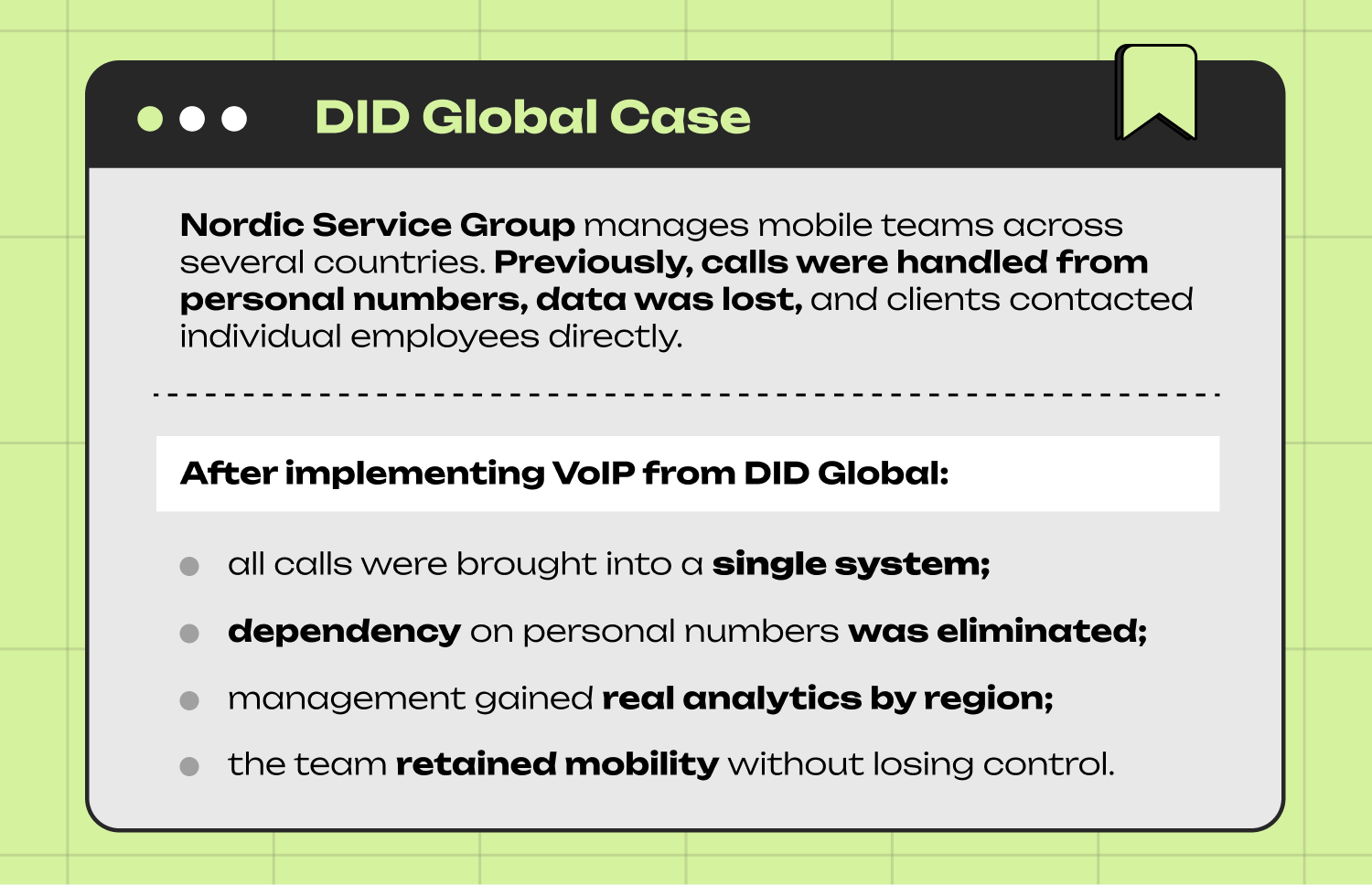
Nordic Service Group manages mobile teams across several countries.
Previously, calls were handled from personal numbers, data was lost, and clients contacted individual employees directly.
After implementing VoIP from DID Global:
Start by asking where exactly you are losing calls, time, and control.
Next, it is important not to assemble solutions piece by piece. Mobile VoIP works only when the architecture is designed from the start: routing, security, analytics, and redundancy.
In such projects, the provider’s experience matters. Teams that turn to DID Global usually begin with an audit of their current telephony and gradually move to a mobile model without disrupting operations. The infrastructure is built around real business processes, not the other way around.