


Thank you!
The form has been successfully submitted
The form has been successfully submitted
Oops! Something went wrong, please try again

In most companies, telephony costs do not seem critical until scaling begins. While a team of 10 people works in a single office, the difference between a traditional telephony model and a SIP trunk is barely noticeable. But when a call center is launched, international destinations are added, or multiple locations appear, costs begin to grow faster than revenue.
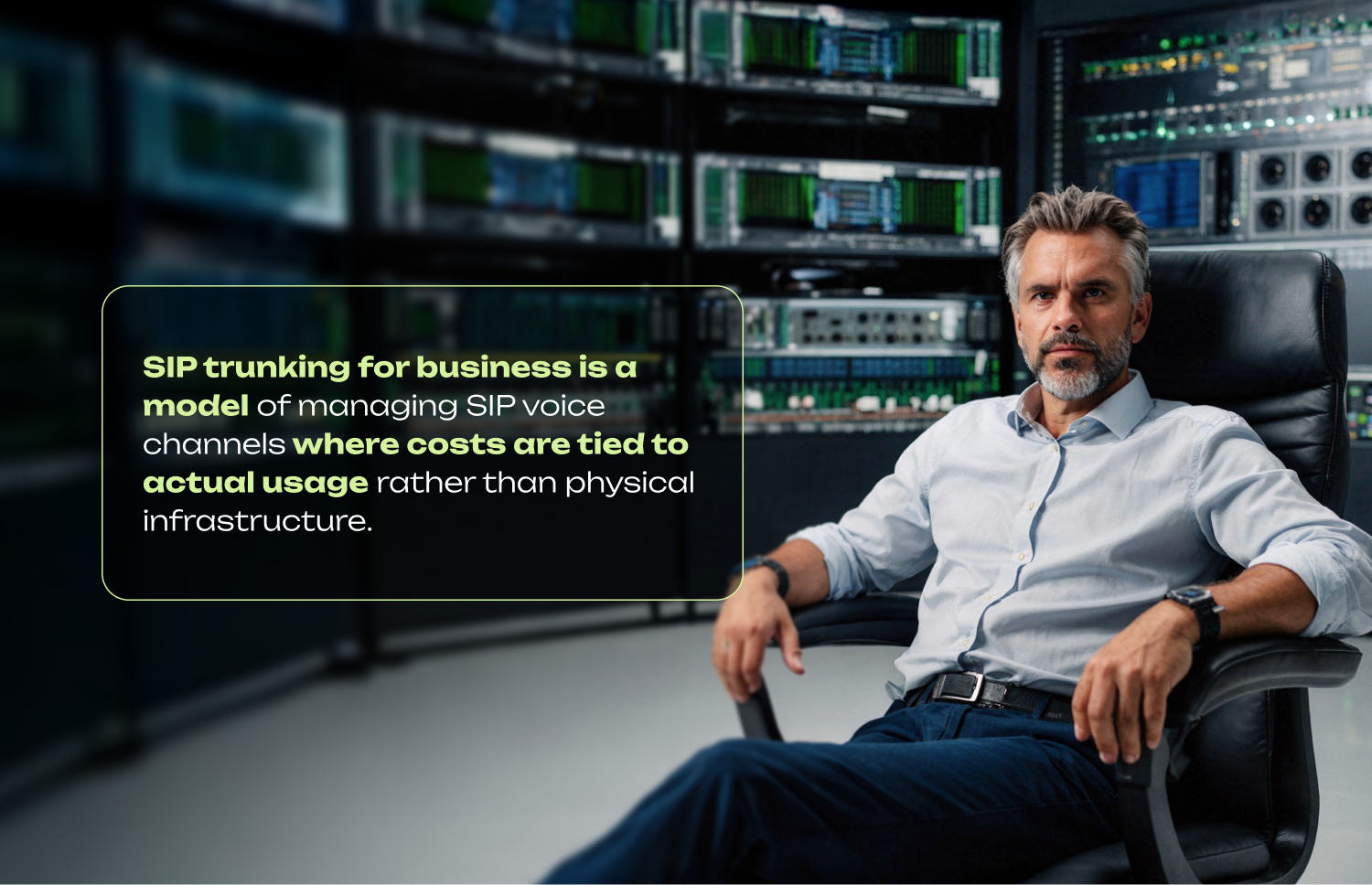
This is where the real potential for communication cost optimization lies.
To assess the impact of migration, it is important to understand the current cost structure. In a traditional model, expenses consist of fixed infrastructure and variable traffic costs. The issue is that the fixed portion does not scale down easily.
A physical PBX, dedicated lines, and service contracts represent fixed expenses. They do not depend on the actual number of calls. Even if traffic decreases, the bill remains stable.
Moreover, any expansion requires additional work: installation, provisioning, and coordination with the carrier. For operations teams, this means delays; for finance teams, additional costs.
VoIP for business via SIP trunking eliminates the need for physical lines. The company no longer invests in cabling infrastructure and instead operates digital channels that can be adjusted without technical intervention.
For businesses serving international clients, a significant portion of the budget is spent on international calls. Traditional tariffs often fail to account for volume and offer limited flexibility.
A SIP trunk provider operates over IP networks and enables traffic route optimization. This means lower call costs to specific destinations without changing processes in sales or support teams.
SIP trunking connects corporate telephony to a carrier over the internet. Instead of physical lines, the company receives digital SIP voice channels integrated with an IP PBX.
The key difference is manageability. Channels become a resource that can be planned similarly to server capacity or cloud storage.
Voice over IP means that all traffic flows through a unified system. This enables precise call accounting and visibility into the real cost structure.

In the traditional model, additional lines are provisioned to handle peak load. As a result, some channels remain idle most of the time.
SIP trunking allows channels to scale according to actual demand. If call center operations experience seasonal peaks, the number of active channels can be adjusted without installation work or long-term commitments.

Migration to SIP trunking makes sense only when it impacts financial performance.
Average load is always lower than peak load. If a company handles 40 concurrent calls at peak but averages 25, the traditional model requires paying for 40 lines continuously.
SIP trunking allows you to size your channel package closer to the average load with the ability to scale flexibly during peaks.
Affordable international calling is the result of proper routing. With a SIP trunk provider, businesses can select cost-effective routes for key destinations.
For companies with significant international traffic, this is one of the fastest ways to reduce call costs.
VoIP solutions for business enable multiple offices to be unified into a single corporate telephony system. This reduces duplicated expenses and simplifies management.
SIP voice channels can be planned around specific campaigns. If the marketing department launches a promotion, operations can temporarily increase channel capacity.
After the campaign ends, capacity returns to the baseline level.
SIP trunk integration with CRM systems links calls directly to revenue. This allows telephony to be evaluated as an investment rather than just an expense.
A call center with 50 agents has an average load of 30 concurrent channels and a peak load of 45.
In the traditional model, the company pays for 45 lines continuously. With SIP trunking, the base package is set at the average load, with short-term expansion available during peak periods.
The difference between fixed peak-level payments and a flexible model creates consistent monthly savings. Additionally, equipment maintenance costs are reduced.
SIP trunking provides the greatest benefit when:
Under these conditions, corporate telephony stops being merely a technical function. It becomes a managed resource with predictable economics and a measurable financial return.