Thank you!
The form has been successfully submitted
The form has been successfully submitted
Oops! Something went wrong, please try again
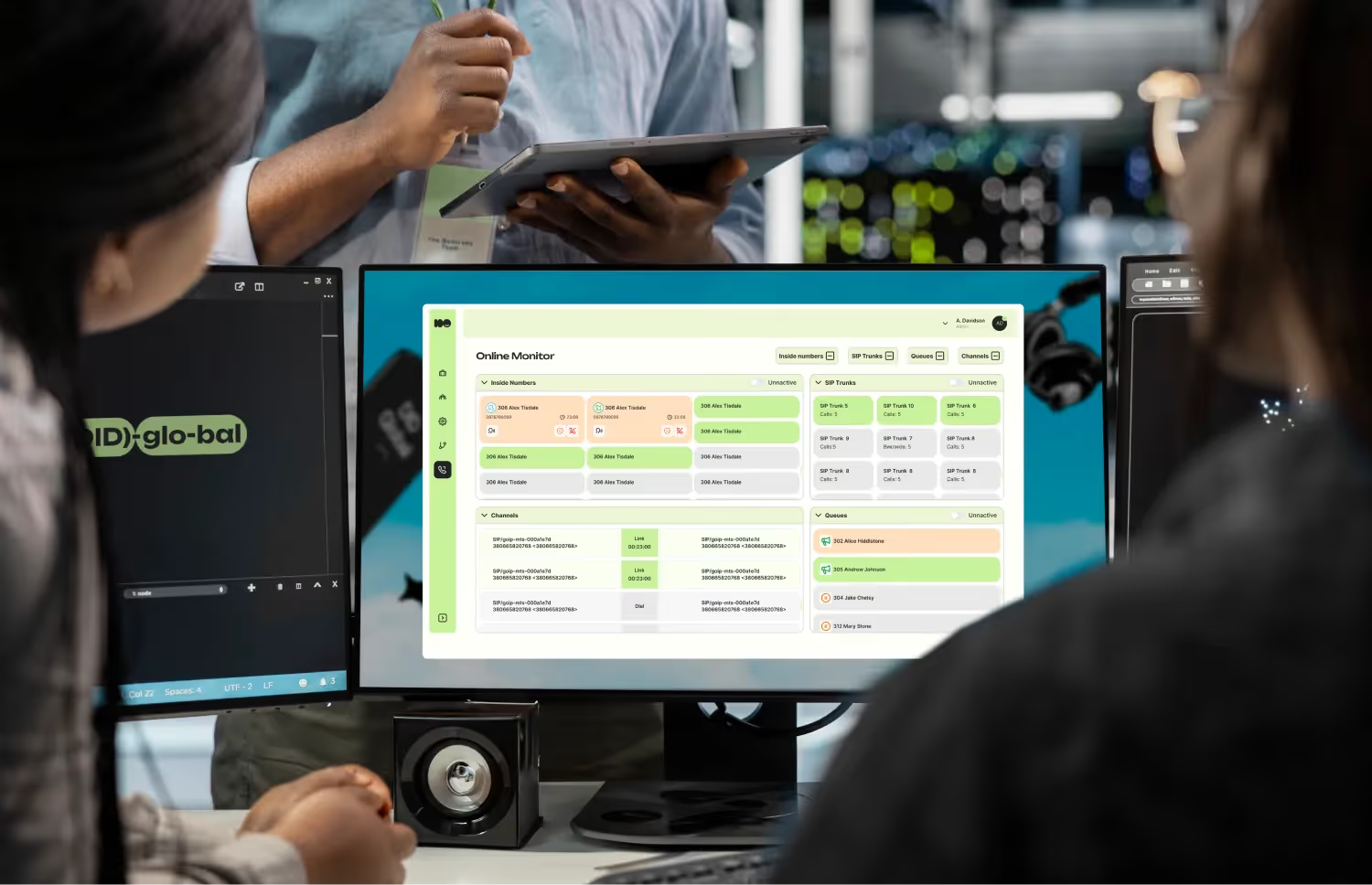
Problems in hybrid work rarely look like system failures.
They show up as missed calls, customers who cannot reach the right person, conversations handled from personal numbers, and managers who get final results without the call-level context.
In a hybrid setup, VoIP keeps voice communication inside one system.
Company numbers stop being tied to desks and office lines. Routing rules, call logs, recordings, and performance metrics stay in one place, even when the team is spread across cities or countries.
Distributed work makes visibility non-negotiable.
Without VoIP, calls scatter across devices and apps, and accountability becomes blurred. With VoIP, every interaction is traceable: who answered, when, how long it lasted, and what happened next.
Phone communication remains a core operational channel for sales and support.
Consistency in delivery, logging, and scaling decides how manageable the business stays as the team grows or reorganises.
The model of “office = telephony” no longer works.
Teams have become mobile, and processes distributed.
This shift is why many companies turn to providers with an infrastructure-first approach, such as DID Global, where voice communication is designed as a managed system rather than a set of disconnected lines.
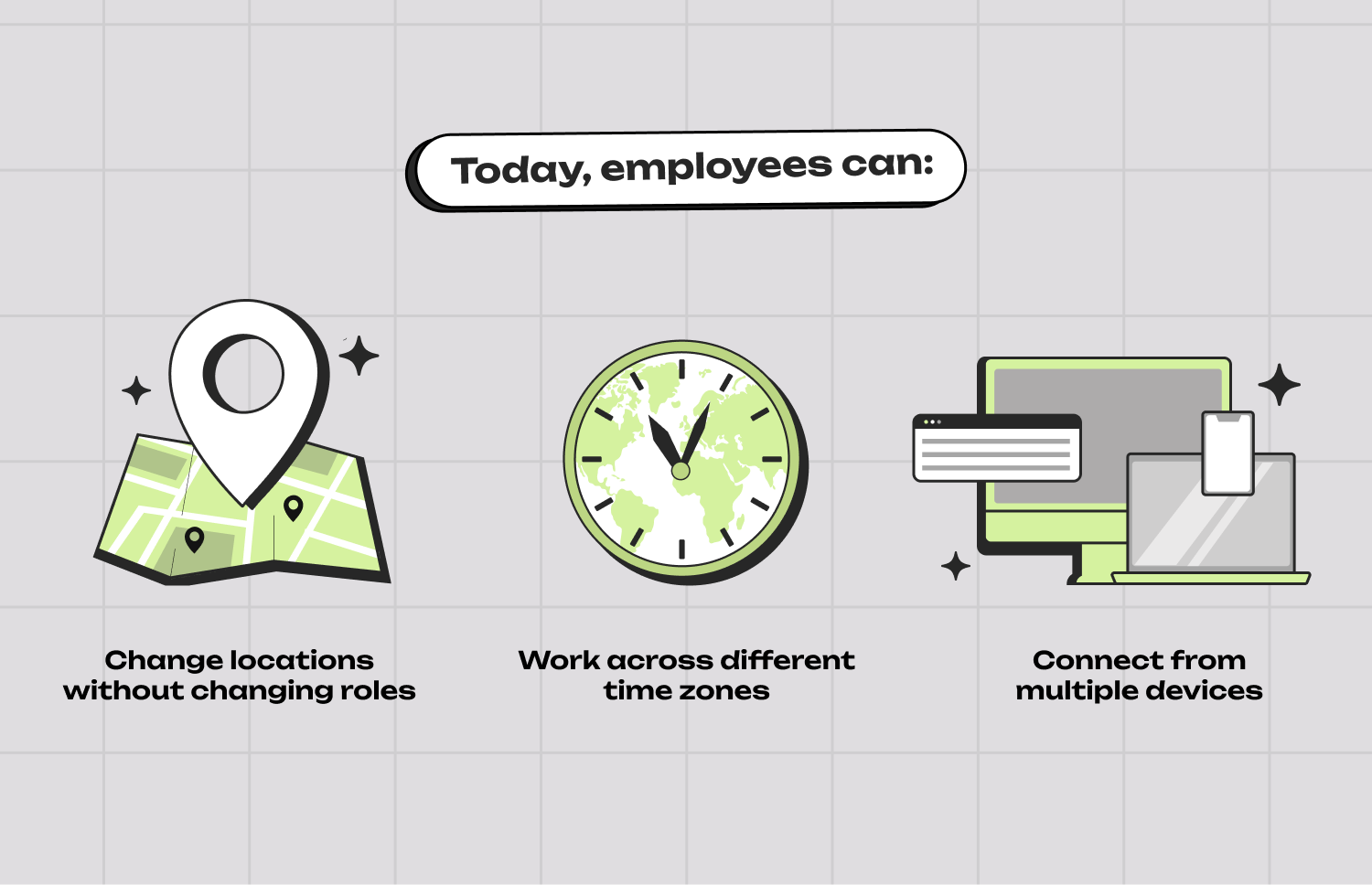
Today, employees can:
If communications are not unified into a single system, a business loses control almost instantly.
In a hybrid environment, communication must do more than simply work.It must be predictable.

A customer doesn’t know that a call “failed due to routing issues.”
For them, it is simply no answer.
That is why stable routing, redundancy, and traffic quality control are the foundation of reliable service.
A hybrid team cannot depend on a physical office.
Telephony must work wherever the employee works, without losing the phone number, call history, or call quality.
VoIP allows companies to maintain a single corporate communication space regardless of where employees are located.
VoIP for remote work is not just “more convenient”. It is more controllable.
Connection, changes, and scaling happen without physical intervention.
For businesses, this means:
This is how the hybrid model stops being a risk.
A cloud PBX is the evolution of office PBX.
It allows companies to build call logic around real business processes rather than hardware limitations.
Companies use cloud PBX systems to:
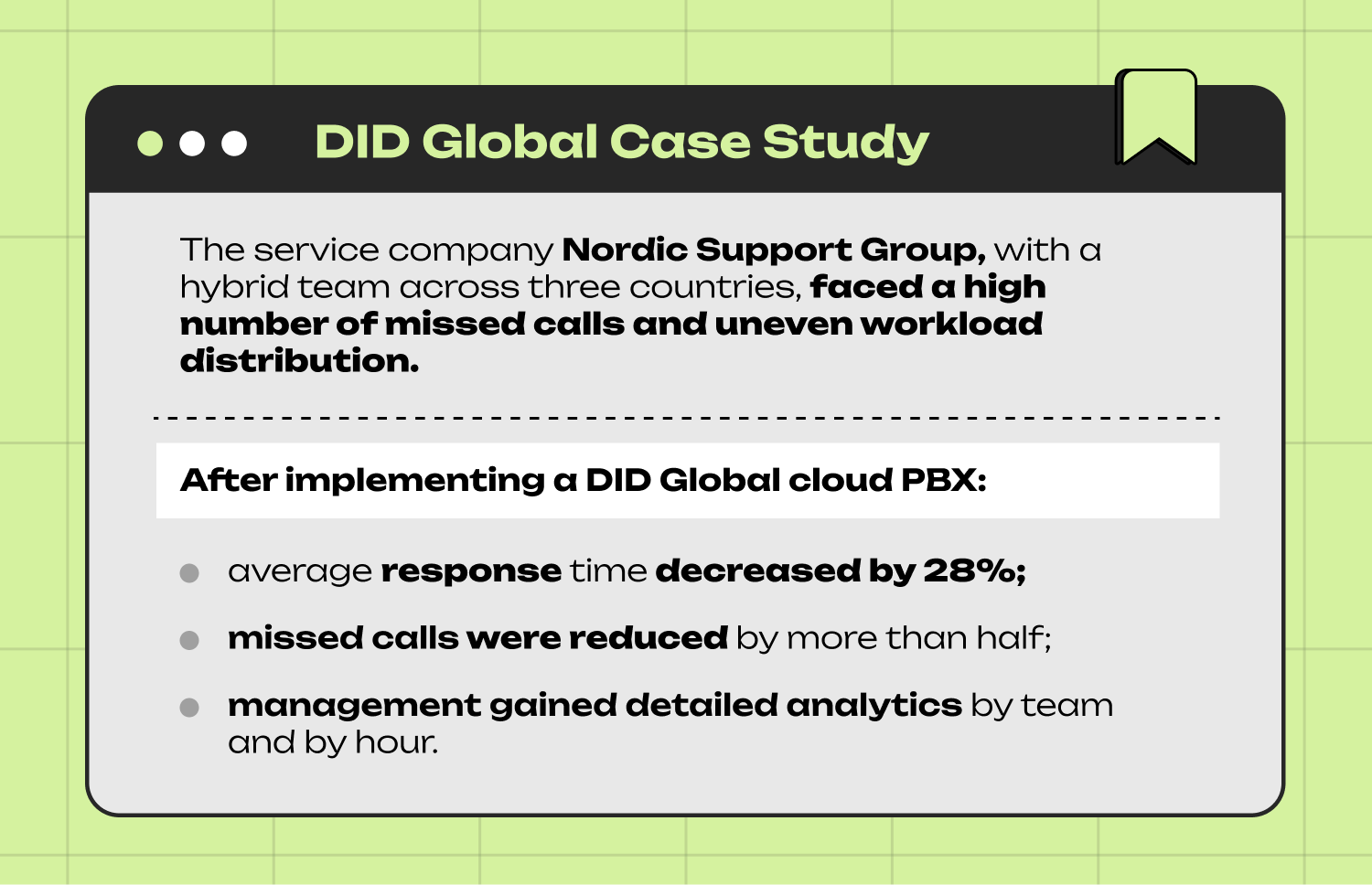
The service company Nordic Support Group, with a hybrid team across three countries, faced a high number of missed calls and uneven workload distribution.
After implementing a DID Global cloud PBX:
In a hybrid model, a call without context is a missed opportunity.
CRM integration makes it possible to see the customer before answering, retain call history, and analyze team performance.
This reduces request handling time and lowers employee workload.
Remote work increases the number of access points.
Without proper control, this leads to fraud, abnormal call activity, and instability.
Modern telecom solutions include:

The hybrid work model quickly exposes weak points in communications. We have gathered the key criteria by which you should evaluate your current telephony infrastructure.
Corporate number accessible from any location
Employees can make and receive calls using the corporate number regardless of where they are — in the office, at home, or in another country. The number is not tied to a physical device or an office line.
Backup routes in case of failures
If there are issues with the primary channel, calls are automatically rerouted via alternative paths without team involvement. This is critical for maintaining SLAs and ensuring uninterrupted contact center operations.
All call history is logged centrally
The company has a complete view of communications: who called, when, with what outcome, and how long the conversation lasted. Data is not scattered across personal phones or different systems.
Telephony integrated with CRM and business systems
Calls are automatically linked to customer records, and managers see context before answering. This reduces request handling time and lowers the number of errors.
Users and numbers added without technical delays
New employees, temporary teams, or project groups can be connected within minutes without installing equipment or involving third-party contractors.
Anomalous activity and call security are monitored
The system tracks unusual patterns, call geography, and potentially risky activity. This reduces the risk of fraud and uncontrolled costs.
If at least two of these points are not met, the telephony infrastructure does not meet the requirements of a hybrid work model and creates operational risks for the business.
Start with business processes, not features. Telephony should support real team workflows rather than forcing teams to adapt to the system.
Plan for scalability from the start. Hybrid teams change quickly, so the infrastructure must support growth without restructuring.
Choose a provider responsible for the infrastructure, not just pricing. Stable routing, redundancy, security, and analytics must be part of the service.
At DID Global, we work with companies that need communication to remain predictable as teams become distributed. Our infrastructure-first approach combines corporate numbers, VoIP, Cloud PBX, and analytics into a single managed system. This allows businesses to move to a hybrid work model without losing visibility, control, or call quality.
Hybrid work is already the standard.
The next step is making sure your telephony is ready for it.
If you want to move forward:
Source: DID Global