Thank you!
The form has been successfully submitted
The form has been successfully submitted
Oops! Something went wrong, please try again

In most businesses, communication with customers is built on a template. One message, one scenario, one logic for the entire database. As long as the volume is small, this does not create problems.
As the number of inquiries grows, the situation changes. Some customers do not respond, some delay action, and some drop out of the funnel entirely. Repeat sales become less predictable, and campaign performance declines even under the same conditions.
The reason is that communication does not take context into account. The customer receives a message without connection to their history, actions, or intent.
Personalization solves this at the process level. It allows interaction to be built not around the database, but around the specific customer and their behavior.
Personalization is no longer a competitive advantage. It has become a basic requirement. Customers expect that a company understands who they are, what they have done before, and why they are reaching out now.
If this is missing, communication feels random and loses value.
Customers do not analyze how your processes are structured. They evaluate the response: how quickly you reply and how relevant it is to their request.
If a message or call looks like a mass communication, it is simply ignored.
In numbers:
A 2–3x difference with the same database size.
The same effect applies to calls.
If a manager starts with clarifying questions, the customer spends time and is more likely to end the conversation.
If the manager goes straight to the point, conversion increases.
For example:
Personalization affects not only the first reaction but also whether the customer returns.
When communication considers context:
In practice, this leads to:
For businesses, this means less dependence on advertising and better use of the existing database.
Personalization does not work on intuition. It is built on data and automation. Without this, communication remains generic, even if it includes the customer’s name.
CRM integration with telephony collects all touchpoints in one place. The manager sees not just a phone number, but the full interaction history.
The system records:
Before the call, the manager understands who the customer is and at what stage they are.
Practical effect:
On average, this reduces lead processing time by 15–25%.
Beyond basic data, customer behavior plays a key role. It determines how and when to interact.
The system considers:
Based on this, segmentation and communication scenarios are built.
Examples:
This approach shifts the focus from an “average customer” to specific behavior, directly impacting conversion.
At this stage, personalization stops being a “marketing function” and becomes part of infrastructure.
If you already have a database and calls, but communication follows generic script, it is worth reviewing how inquiries are distributed, what data is actually used, and where context is lost.
DID Global helps set up VoIP telephony and SMS so that each contact is handled based on customer history, not a single template.

Personalization at DID Global is built at the level of routing, data, and scenarios. Not through “individual texts,” but through how each contact is processed.
VoIP telephony is integrated with CRM so that every call has context immediately.
Before connection, the manager sees:
All contacts are automatically recorded:
This allows building scenarios based on data, not general assumptions.
For example, separate scenarios for new leads and returning customers.
Routing is configured according to business logic, not the standard “first available” approach.
Typical scenarios:
This delivers clear results:
Telephony and SMS work as a single chain, not separate channels.
Example flow:
Other scenarios:
As a result, communication feels logical and consistent. The customer does not receive random messages but follows a clear interaction path.
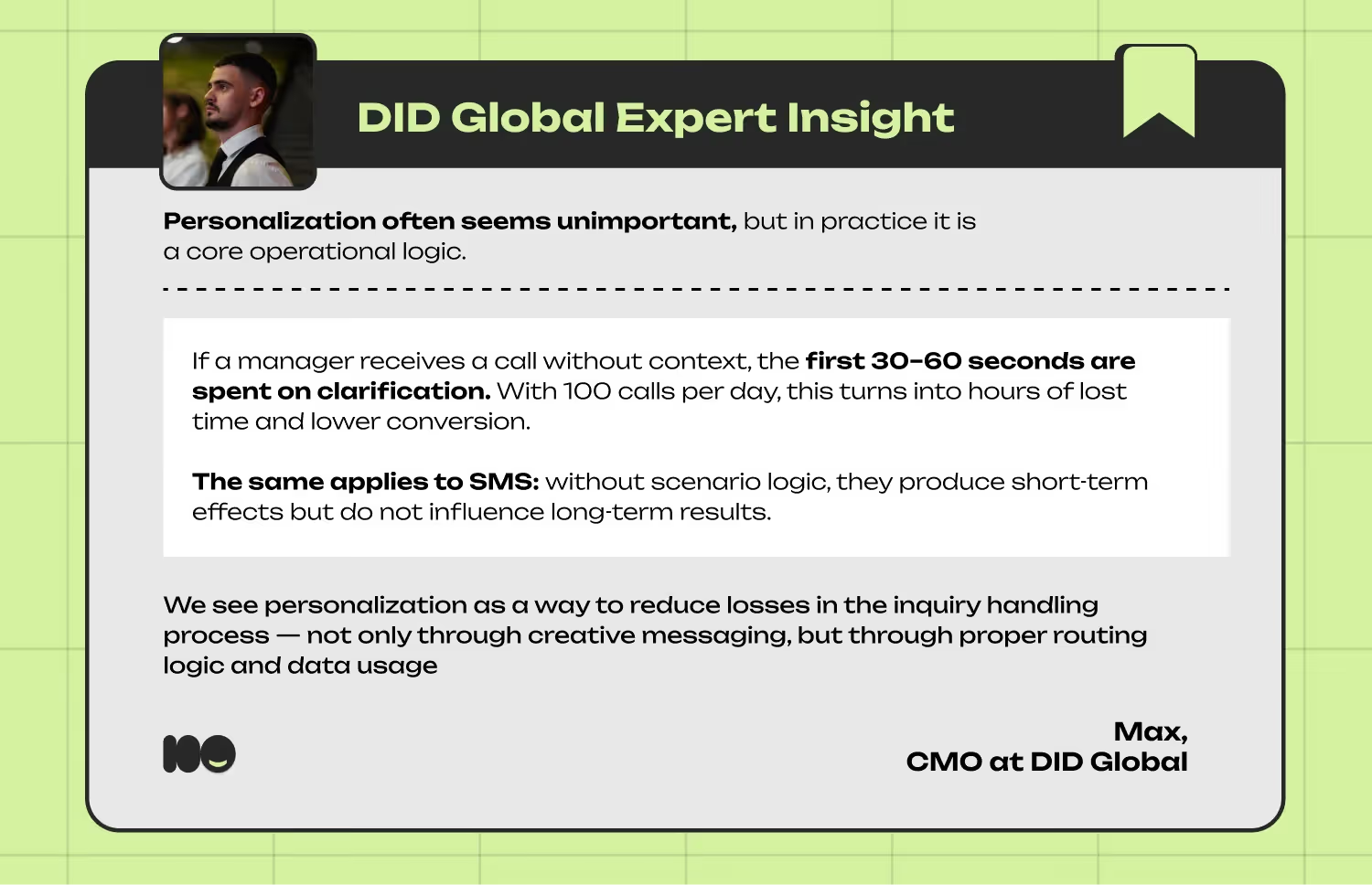
Personalization impacts not just individual metrics, but the entire logic of handling inquiries. This becomes visible in the numbers.
Typical improvements after implementation:
In call centers, this adds:
One of DID Global’s clients, a SaaS company, worked with inbound leads from multiple GEOs. The main issue was uneven handling and low conversion at the first contact.
Before implementation:
What changed:
Results within 2–3 weeks:
The key change: leads stopped getting lost between channels. Each contact is handled within a single scenario, without breaks in communication.
In such cases, results are achieved not by increasing traffic, but by processing existing inquiries consistently and without loss.
Personalization starts not with tools, but with process structure.
Basic steps:
Even basic segmentation and integration already produce noticeable results.
DID Global helps build personalized business communication through VoIP telephony, SMS, and analytics in a single system.
The company receives not just a communication channel, but a controlled interaction model where every contact has context and logic.
Call analytics only makes sense when it is integrated into processes: CRM, routing, and team operations.
DID Global provides analytics as part of VoIP telephony: with call tracking, call recording, and full CRM integration. This allows visibility not just into individual calls, but the entire lead handling process.
If calls already exist but there is no clear understanding of what happens to them, it is worth starting with analysis. This delivers results faster than increasing the advertising budget.