


Thank you!
The form has been successfully submitted
The form has been successfully submitted
Oops! Something went wrong, please try again

A Cloud (Virtual) PBX has long stopped being an experiment for individual teams. According to industry research, the cloud telephony market is growing by more than 14% annually, and companies are increasingly switching to VoIP telephony due to remote and hybrid work models. This means one thing: telephony is becoming part of a business’s operational infrastructure.
According to Research and Markets, the global Cloud PBX market will exceed $58 billion by 2032, which clearly indicates a shift in how companies approach corporate communications.
That is why the choice of a virtual PBX directly affects service speed, team workload, and overall business manageability. Most issues arise from mistakes made at the selection stage.
A PBX is part of a company’s operating system. It directly affects:
If the system limits scalability or does not provide a complete picture of calls, the business loses control long before this becomes visible in financial reports.

The most common scenario is choosing a PBX based on the lowest rate. While the team is small, this may work. As call volumes grow, problems appear: instability, feature limitations, and difficulty making changes.
How to avoid it:
Look beyond the price and evaluate what stands behind the service: infrastructure, redundancy, analytics, and support. A cheap solution without these elements often costs more in real operations.
A PBX may work well for 5–10 people but start to slow down as the team grows or new departments appear. Adding users, numbers, or queues turns into a separate project.
How to avoid it:
Choose a system that scales programmatically, without equipment installation, downtime, or complex coordination.
When a PBX is not integrated with a CRM, calls exist separately from customer data. Managers lack context, information is recorded manually, and analytics become fragmented.
How to avoid it:
Check whether the PBX supports CRM integrations or APIs for CRM and service systems. A call should be part of a business process, not a standalone event.

Features such as IVR or call recording are important, but the decisive factor is how calls are actually delivered to operators. Poor routing increases queues, response times, and team workload.
How to avoid it:
Evaluate call distribution logic, priorities, time-based rules, and the availability of backup routes. For call centers, this is one of the key stability factors.
Even an automated system requires support. When failures or non-standard situations occur, businesses need results, not explanations.
How to avoid it:
Choose a PBX with real technical support that works with infrastructure, not just the interface. In DID Global’s approach, system stability and telephony control are treated as part of the service, not an optional add-on.
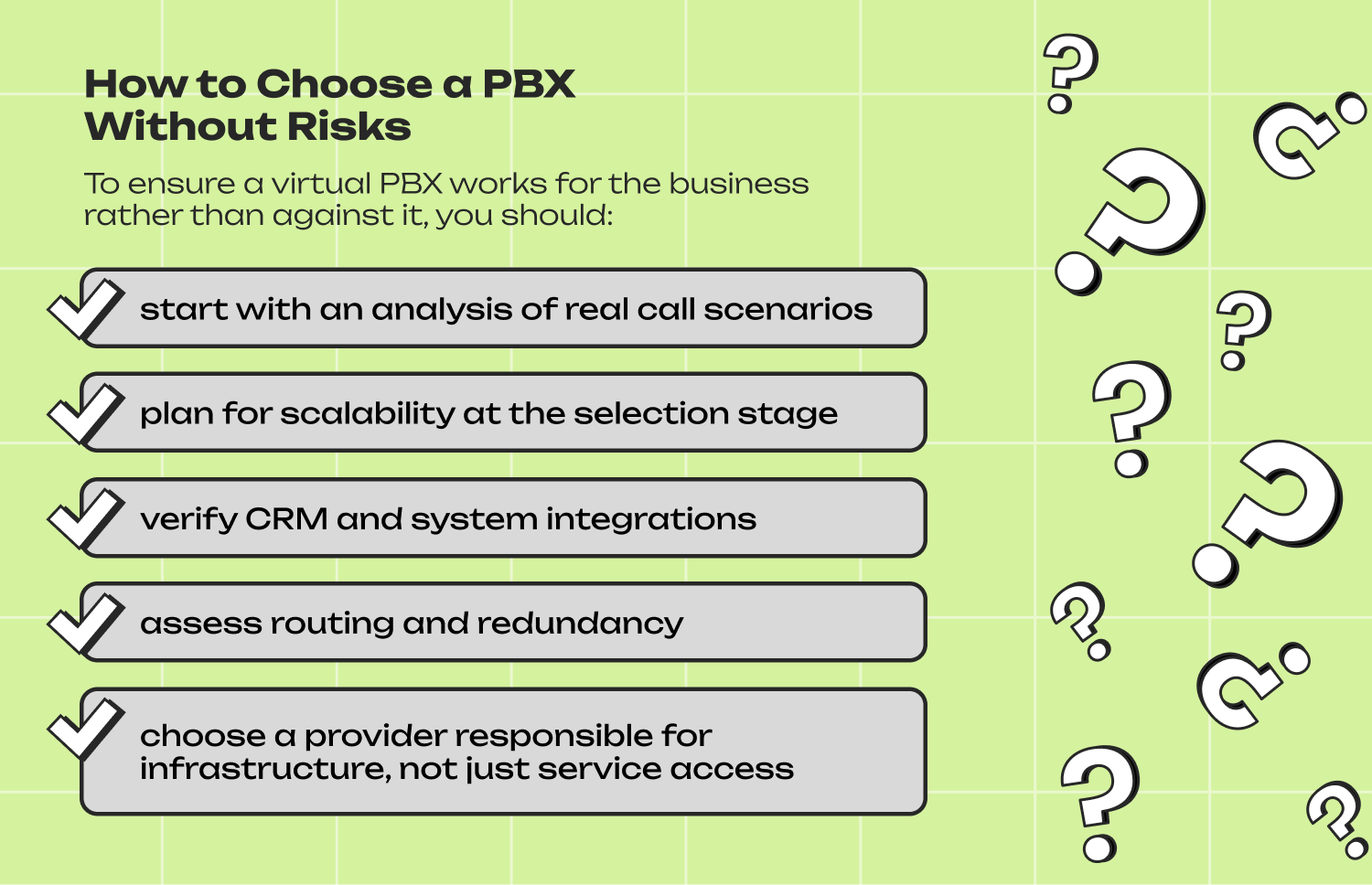
To ensure a virtual PBX works for the business rather than against it, you should:
This is the approach used at DID Global, where a virtual PBX is treated as part of a business’s voice infrastructure rather than a standalone software product.
A virtual PBX is about manageable telephony that grows with the business and does not create hidden limitations.