Thank you!
The form has been successfully submitted
The form has been successfully submitted
Oops! Something went wrong, please try again

In many companies, SMS exists separately from business logic. It is used for confirmations, reminders, or technical notifications, without being treated as part of the sales and service system. In this model, the channel rarely delivers measurable results.
SMS starts working for the business when it is seen not as a broadcast tool, but as a way to manage customer actions. At this point, it affects both revenue and loyalty without increasing marketing budgets.
SMS almost never creates demand. Its role is to eliminate losses at moments when a customer is already ready to act, but the process breaks down.
Most often, this happens during:

At company scale, these failures look like thousands of unfinished actions every month. They may not always stand out in weekly reports, but they directly impact monthly revenue.
One project handled by the DID Global team involved an international online platform with heavy service operations and user notifications. SMS was used as an operational channel to inform users about order statuses and service changes.
At the early stage, the system worked reliably. Problems appeared as the audience and traffic volume grew:
The team tried adjusting message content and sending times, but this had no effect. The root cause was the delivery infrastructure.
After switching to DID Global’s SMS infrastructure with route control and priority delivery:
This did not look like a dramatic performance spike. But losses that had previously seemed inevitable during scaling simply disappeared.
Loyalty is not formed at the moment of sale. It emerges through small service details that customers rarely notice consciously, but clearly feel.
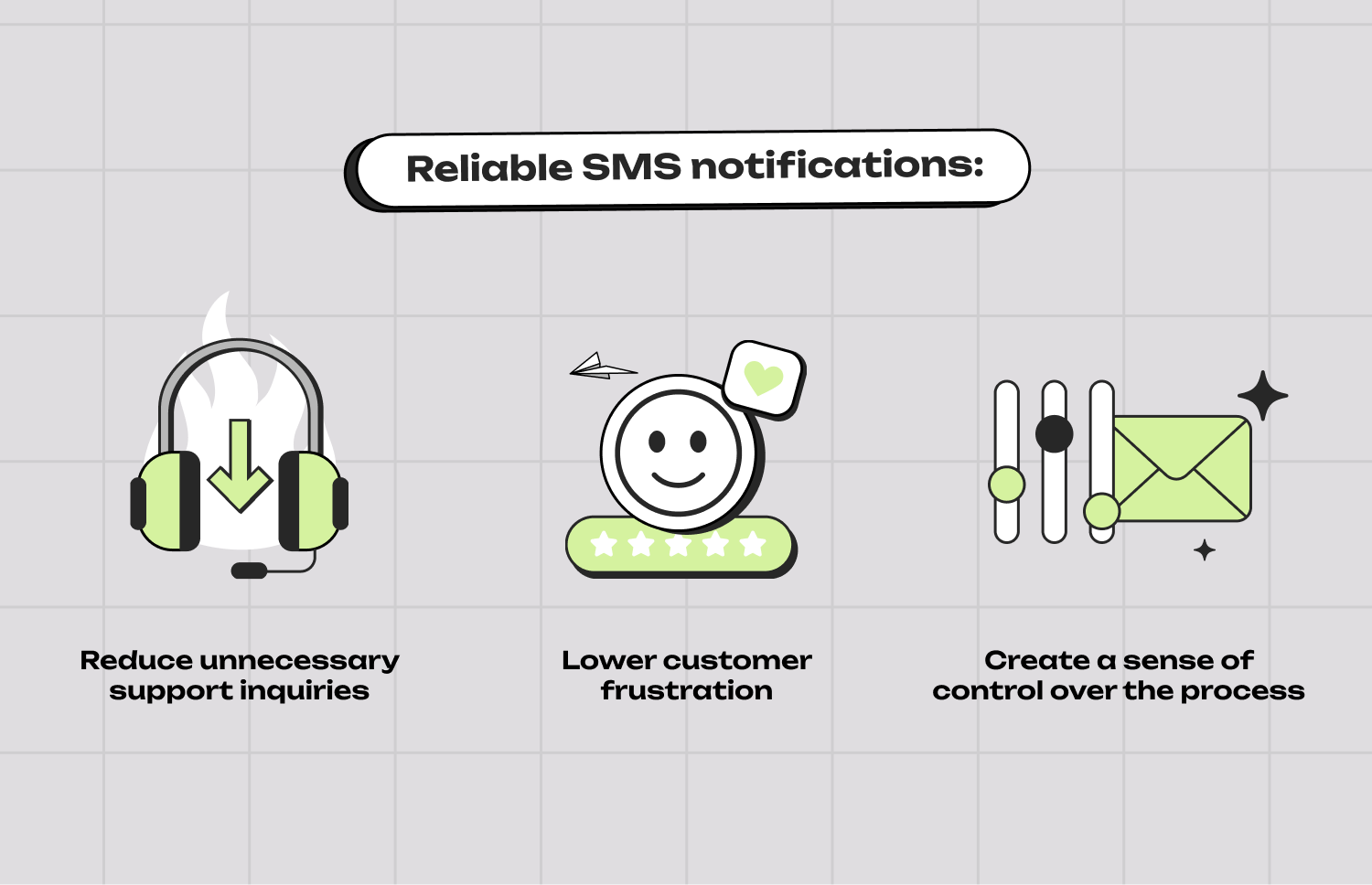
According to DID Global clients, implementing clear service-related SMS scenarios reduces repeat support requests by 15–25%. The product and pricing remain unchanged. Only the way customers interact with the service changes.
Most problems arise when a business grows.
Typical causes include:
What worked with thousands of messages begins to fail at tens of thousands. At that point, SMS turns from a useful tool into a source of risk.
The difference between a chaotic and a systematic SMS approach becomes clear quickly.
In the first case, the channel looks like a cost. In the second, it becomes a controlled asset.
DID Global’s approach is built around manageability:

In this model, SMS does not require constant manual intervention and does not create problems as load increases.
SMS does not directly increase sales. It removes the points where businesses lose them often without realizing it.
When SMS is integrated into processes, operates reliably, and is controlled at the infrastructure level, it becomes part of the company’s operational logic with measurable impact.
In this format, SMS stops being a supporting channel and starts functioning as a full-fledged business solution.