

Thank you!
The form has been successfully submitted
The form has been successfully submitted
Oops! Something went wrong, please try again

Telephony is rarely included in strategic business planning. It is perceived as fixed infrastructure that “just has to work.” Problems arise gradually as operational complexity grows. As the number of employees increases, remote teams appear, and the volume of inbound and outbound calls grows, the load on the system changes while the communication model itself remains the same.
At this point, the loss of control becomes systemic: calls are distributed unevenly, workloads between teams are not balanced, and management sees aggregated metrics without the ability to understand their causes. The difference between a traditional phone and a virtual number appears not at the technology level, but at the level of process manageability and the system’s ability to adapt to changes in the business.
Classic telephony is built around physical logic: number → line → device → location. This model works well where the business is stable and changes little. One office, a fixed schedule, a limited number of calls.
The problem is that modern businesses rarely stay within these boundaries.
The first serious issue appears as a loss of transparency. When part of the team works remotely, calls begin to “spill” across different channels. Some go through the office, some through personal phones, others through temporary solutions.
The second limitation is scalability. Each new number or line requires time, coordination, and technical work. During peak periods, a business either overpays for excess lines or faces overload.
The third is analytics. Classic telephony almost never answers the question “why.” It shows the fact of a call but does not explain workload, losses, or team efficiency.

A virtual number changes the very logic of telephony. The number is no longer tied to a physical location and becomes part of a VoIP system. Calls enter centralized infrastructure, where they are routed according to business rules rather than cables.
A DID number allows telephony to be built as a system. One number for sales, another for support, separate ones for regions or campaigns. All of them operate in a single environment with the same accounting and analytics rules.
The key insight is that the number becomes a data collection point. The business sees not only the number of calls, but also peaks, delays, repeat contacts, and the load on specific teams.
This explains why, according to industry analytics, switching to VoIP and virtual numbers allows businesses to reduce telephony costs by 50–75% by eliminating inefficient infrastructure rather than lowering tariffs.
To compare these two approaches correctly, it is important to look beyond connection costs or per-minute rates. For businesses, three parameters are decisive: how the system behaves as it grows, how quickly it adapts to change, and whether it allows calls to be managed as a process rather than a set of separate lines. By these criteria, the difference between classic telephony and virtual numbers becomes clear.
At the start, a traditional phone seems simpler and cheaper. But this economy works only in a static environment. As soon as new teams, locations, or peak loads appear, costs grow disproportionately.
Virtual numbers scale through software. Adding numbers, changing routes, or redistributing load does not require physical work. Control becomes centralized: the business sees where the system performs well and where it creates losses.
The key difference is manageability. A traditional phone provides connectivity. A virtual number provides control over connectivity.
Classic telephony may remain sufficient for small local businesses with no growth plans and a fixed team.
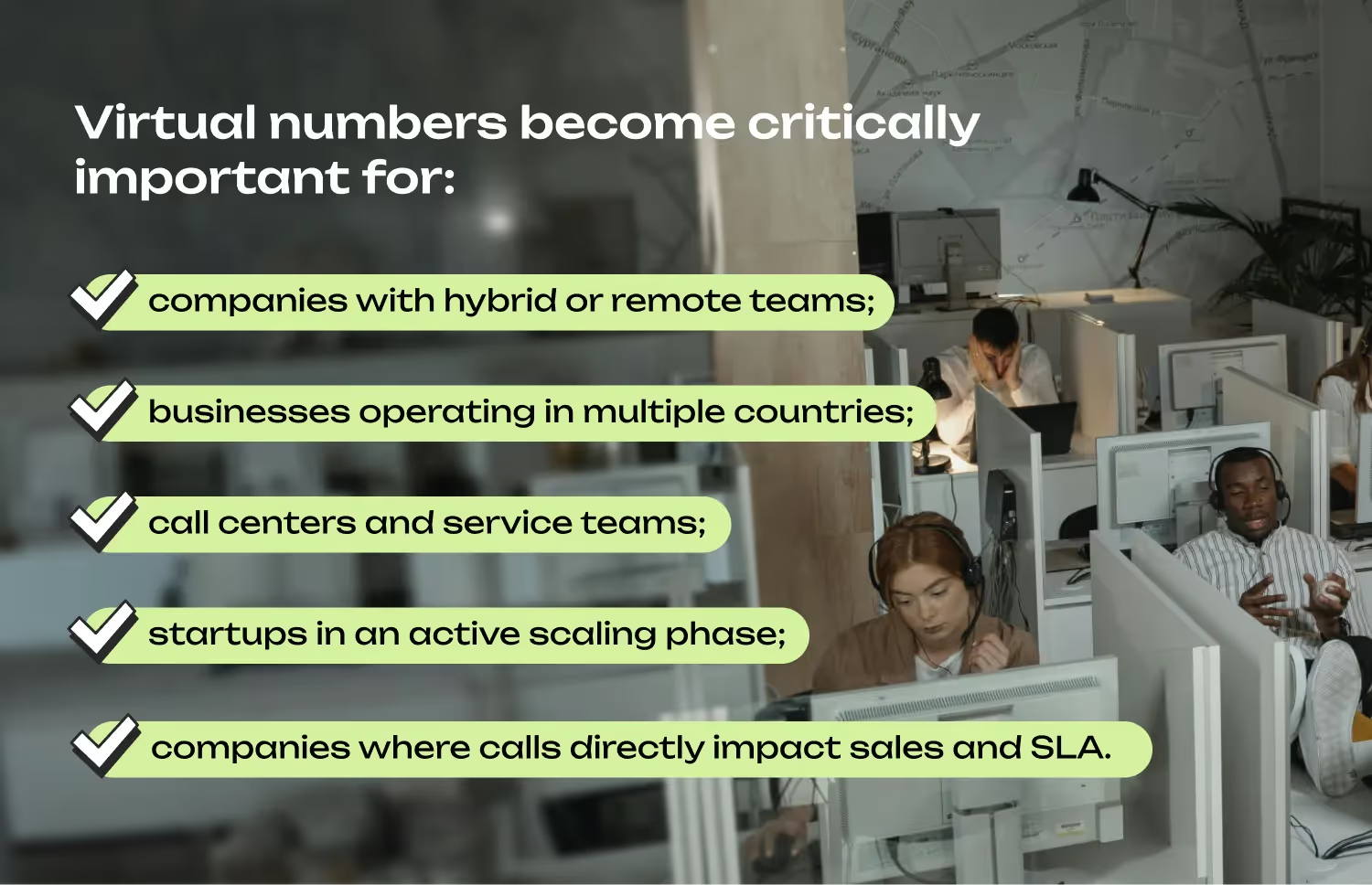
In these scenarios, telephony without analytics and flexibility begins to slow growth.

The right choice starts with the question: can telephony adapt to change faster than the business?
Companies that view communication as part of their operating system choose an infrastructure-based approach. Where numbers, routing, analytics, and integrations work as a single whole, growth does not lead to chaos.
In DID Global’s practice, businesses often start with a single virtual number. Regional lines, contact centers, and CRM integrations are then added without rebuilding the architecture. This helps prevent communication issues.
A virtual number is about ensuring that telephony supports business growth and helps scale operations.