


Thank you!
The form has been successfully submitted
The form has been successfully submitted
Oops! Something went wrong, please try again

There is one uncomfortable truth in voice marketing: a call may never reach the customer, even if the number is active and the network is working.
The reason is simple. Modern carriers and mobile platforms have long learned how to distinguish “normal calls” from traffic that looks suspicious. And they do this automatically. Without explanations. Without warnings.
This is where a call spam checker comes in – a tool that allows marketers to see risks before they turn into a failed campaign.

A spam checker in voice campaigns does not analyze text or scripts.
It analyzes call behavior.
Marketers use it not as a formality, but to answer very practical questions:
In real workflows, a spam checker is used before scaling outbound campaigns, before launching new numbers, and when answer rates drop without an obvious reason.
In the voice channel, deliverability comes down to one question: does the customer answer?
Carriers and devices evaluate:
When these parameters move outside a “normal” profile, calls start to:
Carriers do not care what you are selling.
They care about how the traffic behaves.
Sudden volume spikes, repeated short calls, calls made at night, or using the same number for multiple campaigns all trigger automated filters.
A spam checker makes these signals visible before the carrier starts restricting traffic.
Every phone number builds a history.
When campaigns run without control, reputation degrades gradually, but the consequences appear suddenly.
A spam checker shows when a number has already entered the “warning zone” and allows marketers to adjust strategy before blocks or severe limitations occur.

In practical marketing, a spam checker is used to:
At DID Global, this approach is applied for clients working with large volumes of voice traffic. Analysis is performed together with routing, not separately from it.
Most issues arise not because of content, but because of organization:
A spam checker makes these issues visible through data rather than assumptions.
In voice marketing, ROI is built on three things:
When deliverability drops, budget burns faster than the team can identify the cause. Controlling spam risks makes it possible to:
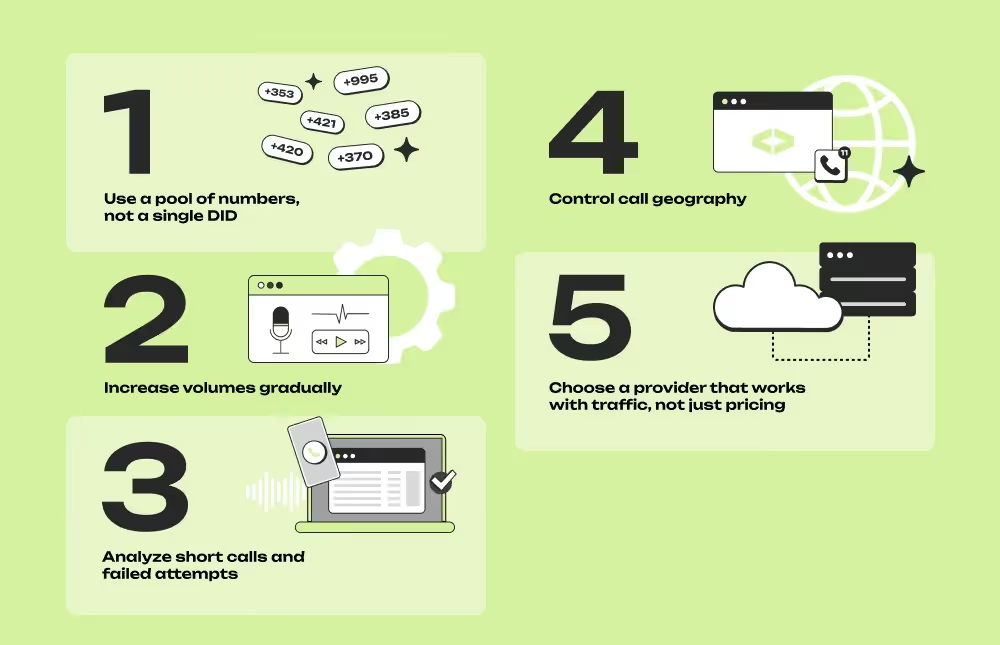
Stability in voice marketing does not happen by accident. It is built through a set of core decisions, each reducing a specific risk.
At DID Global, the call spam checker is integrated with route analytics and number reputation monitoring systems. This makes it possible not just to detect problems after contact rates drop, but to identify risks at the campaign planning stage and adjust traffic before it falls under carrier restrictions.
This approach gives marketing teams predictable outbound campaign performance and maintains a stable answer rate even as volumes grow.