
Thank you!
The form has been successfully submitted
The form has been successfully submitted
Oops! Something went wrong, please try again

In most teams, call performance is evaluated through scripts, leads, or manager performance. But there is a level that is often not checked – how exactly the call reaches the customer.
With a volume of 300–500 calls per day, even 10–20% of calls may not turn into a normal conversation. Some end before connection, some receive no answer because of how the number appears to the customer. This is not always visible in CRM. The system records the call, but not the reason for the loss.
As a result, 30–100 contacts drop out daily before any dialogue begins. These are direct losses that cannot be compensated by scripts or additional traffic.
A Virtual Number impacts exactly this stage. It determines how the customer sees the call and whether the contact happens at all.
A virtual number is a phone number that operates through IP infrastructure and is not tied to a physical line or specific location.
From the customer’s perspective, it looks like a regular local number with a country code and familiar format.
For the business, this number is connected to a call processing system. Each call enters the infrastructure, where routing, connection speed, and handling point are determined.
The result depends on how this system is configured: how traffic is distributed, whether there are backup routes, and how calls are handled under load.
.png)
A DID number acts as an entry point into IP infrastructure. After dialing, the call does not go directly to a manager. It passes through several processing layers where routing and connection conditions are determined.
After dialing, the call is initiated via SIP and passed along a chain of routes. In a typical setup, it goes through transit nodes, a termination point, and an internal distribution system.
At these stages, the call result is formed. If one of the routes is overloaded or unstable, connection time increases, delays appear, or some calls do not reach conversation.
In practice, it looks like this: the call is recorded in the system but does not turn into contact. The operator is available, but the call does not reach them. With 300–500 calls per day, even 10–15% of such cases result in dozens of lost inquiries.
If the system has no backup routes, traffic is not redistributed. All limitations of one route immediately affect the result.
Caller ID determines how the number is displayed to the customer. This affects the decision to answer even before the conversation starts.
In some countries, numbers without a local code or with an unfamiliar prefix receive lower trust. In such cases, some calls do not reach the subscriber or are ignored.
This is not always visible in analytics. The system shows the call but not the reason for the lack of response.
There is another practical aspect. Local numbers are more likely to be answered within the first seconds. International numbers are more often ignored or answered later. This affects contact speed and overall conversion.
The difference becomes noticeable as load increases.
When call volume is low, both options perform similarly. As volume grows, delays appear, some calls are not processed, and results become unstable.
At this point, it becomes important how the infrastructure behind the number is built and whether it can handle traffic without losses.
In a traditional model, a number is tied to a specific line. The number of simultaneous calls is limited, and when exceeded, some calls are not processed or are queued.
In a cloud model, the number operates as part of IP infrastructure. Calls are distributed within the system rather than through a single physical point. This changes behavior under load.
As traffic increases, the system does not hit a limit but redistributes calls across routes and handling points. If one direction is overloaded, traffic switches to another. If volume changes, the system adapts without manual intervention.
This is especially noticeable at 300–500 calls per day. In a physical model, some calls start to be lost or delayed. In a cloud system, the same volume is processed steadily without queues or losses.
DID numbers are used in different scenarios, but in all cases, they impact the first stage of the funnel, whether contact happens.
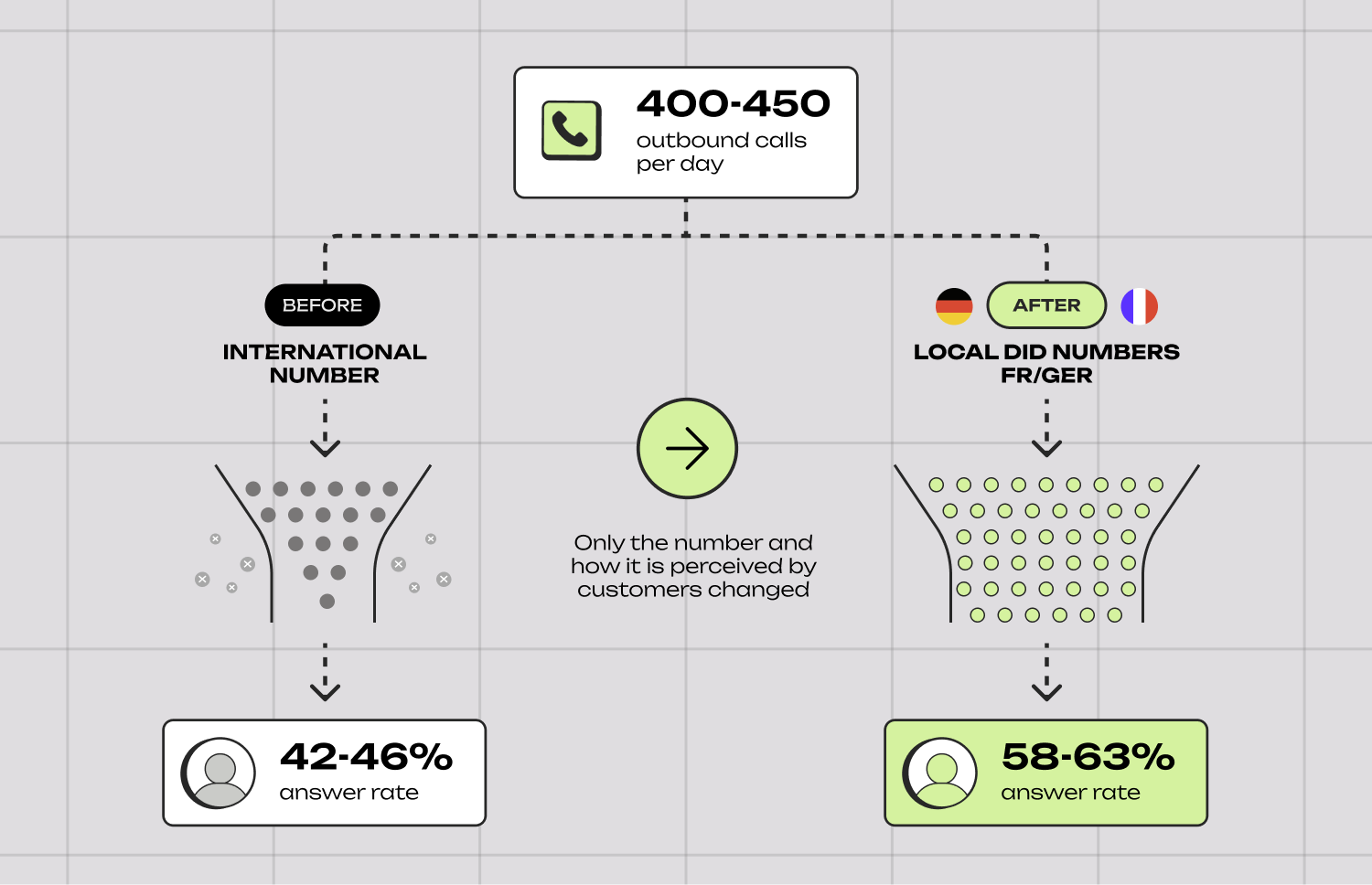
One DID Global case involved an international e-commerce company working with customers in Germany and France.
Before changes, calls were made from an international number. With a volume of around 400–450 calls per day, the answer rate was 42–46%. Some customers did not answer, and some calls ended without connection.
After connecting local DID numbers in each GEO, performance changed within the first week. Answer rate increased to 58–63%, adding about 70–90 additional connections per day. The share of short calls under 5 seconds noticeably decreased.
Traffic volume, scripts, and team remained unchanged. Only the number and how it was perceived by customers changed.
In call centers, this effect scales. At 500–600 calls per day, a 12–18% difference in answer rate means 60–100 additional contacts daily — volume that was previously lost before conversation.
In outbound sales, this directly affects results. With a 5–7% conversion rate, 80 additional contacts can generate 4–6 deals per day without changes in marketing.
In SaaS scenarios, the effect is reinforced by speed. Local numbers are answered faster, reducing time to first contact and the need for repeated attempts.
As a result, a DID number increases the number of real conversations reaching the team.
The impact of a number is visible at the first stage of the funnel, whether a call turns into a conversation. This is easy to measure but often not analyzed separately.
Answer rate shows the percentage of calls that reach an answer.
With 1,000 calls, even an 8–12% difference is significant. An increase from 50% to 60% means +100 additional contacts without changing traffic.
In real scenarios, the difference between international and local numbers often provides a 10–20% increase. At 300–500 calls per day, this means dozens of additional conversations daily.
Conversion starts with contact. If a call does not turn into a dialogue, it cannot affect the result.
With a 5–7% conversion rate, every additional 50–100 contacts can generate 3–7 deals per day. This effect is achieved without changes in scripts, team, or marketing.
In this case, infrastructure directly impacts the final result, not just technical metrics.
If there is a drop at the call stage in your funnel, it is worth checking how the number affects responses.
In DID Global practice, selecting local numbers and adjusting their usage often increases connections by 10–20% without changing ad spend.
Connection takes from a few minutes to one business day depending on the country and operator requirements.
After activation, the number is immediately put into operation. It connects to CRM, integrates into routing, and begins handling calls in the overall flow.
The critical stage is configuration. This is where it is determined how the system will behave under load and whether losses will occur.
If some calls are not turning into conversations, the reason is often at the number level.
Submit a request, we will check your current metrics and show how many contacts you are losing. Then we will select numbers for your GEOs and traffic type so these calls start reaching your team consistently.