Thank you!
The form has been successfully submitted
The form has been successfully submitted
Oops! Something went wrong, please try again

In most companies, communication has long gone beyond a single channel. Calls, SMS, email, and messengers operate in parallel and cover different stages of interaction with the customer.
The problem appears when these channels are not connected. Some inquiries get lost between them, some never reach processing, and the customer has to repeat the same information multiple times.
If you have 1,000 contacts per week, even a 10–15% loss means 100–150 interactions that never turn into proper communication. In reports, this looks like an “average result,” but in reality, these are lost opportunities.
Multichannel means that a business uses several channels at the same time. For example, a customer may receive an SMS, then write in chat, and later call.
Each channel works separately. Data is not unified, and the interaction history is fragmented.
In practice, it looks simple: a manager on a call does not see that the customer wrote in chat. In chat, previous calls are not visible. This increases handling time and reduces communication quality.
As long as the volume is low, this is not critical. But as it grows, it starts to directly affect results.
Omnichannel is an approach where all channels are unified around customer data.
The system combines data across identifiers such as phone number, email, or customer actions. As a result, one customer does not split into multiple records.
The manager sees the full context before the conversation begins and can get straight to the point.
CRM becomes the center through which all communication flows.
VoIP, SMS, email, and chats are connected to one system. Data is transferred between channels and influences further actions.
For example, if a customer does not answer a call, the system can automatically send an SMS. If they open the message, a follow-up task is created. If they write in chat, the call is routed to the appropriate manager.
Communication becomes consistent and manageable.
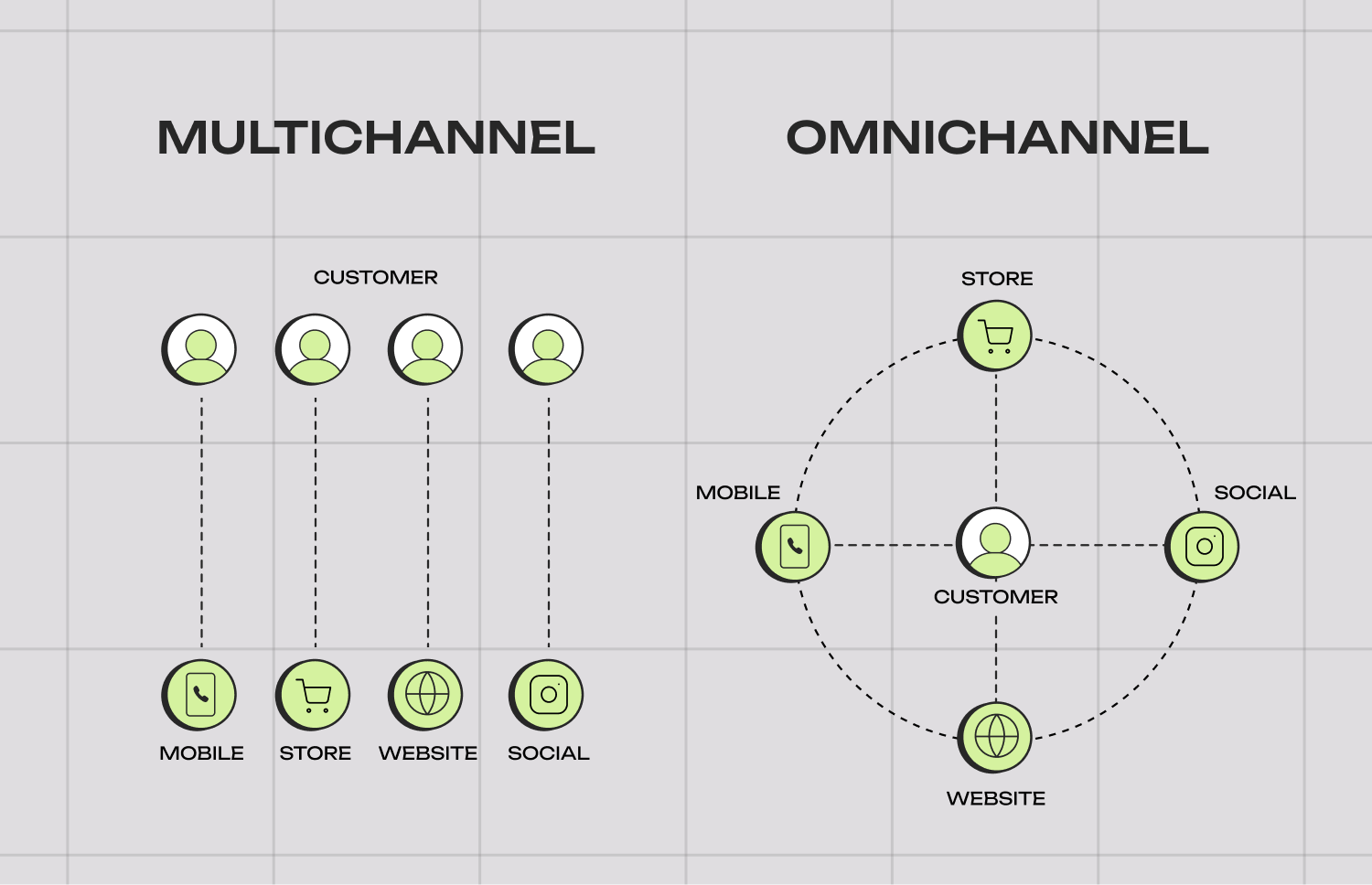
The difference between these approaches is not in the number of channels, but in how customer interaction and data are structured.
In a multichannel model, each channel operates independently. A customer can submit a request, write in chat, and call, but these actions are not connected.
As a result, the conversation starts from scratch at each step. The manager clarifies basic information, the customer repeats their request, and contact time increases.
In an omnichannel system, all interactions are connected. If a customer moves from chat to a call, the manager already sees the history and works with context.
This reduces handling time by 20–30% and lowers the number of incomplete inquiries, especially with high request volume.
In a multichannel model, data is distributed across channels. Calls, SMS, and email are analyzed separately, making it difficult to understand how the customer moves between them.
In an omnichannel system, all touchpoints are combined into a single analytics view. The full customer journey is visible from the first interaction to the deal or drop-off.
This makes it possible to clearly identify:
Without this approach, businesses optimize individual channels but cannot see what happens between them or why some interactions do not lead to results.

In SaaS, response speed directly affects results. If a customer submits a request and does not receive a response within the first 5–10 minutes, the chance of closing a deal drops by 30–50%.
In a DID Global case, a B2B SaaS platform in marketing automation worked with clients in Europe and North America. The main flow was inbound leads from the website and ad campaigns.
Initially, all channels operated separately: calls, SMS, and website forms were not connected.
What happened in the process:
The average time to first contact was around 10–12 minutes. Some requests never reached a conversation.
After integrating channels through CRM and setting interaction logic, the process changed.
How it worked:
As a result:
Traffic, team, and scripts remained unchanged. Only the channel logic changed.
In this case, omnichannel did not increase leads — it ensured that more of them reached actual conversations.
The omnichannel approach affects not only the first contact but also repeat interactions and long-term customer value.
When channels are unified, the business controls not individual touchpoints but the entire customer journey. This allows recovery of customers who previously dropped out between channels.
Even if just 10% of these customers return, it directly impacts LTV without increasing marketing spend.
In practice:
Customer behavior also changes:
Another important effect is reduced acquisition cost. When more customers return, dependence on paid traffic decreases.
As a result, the business gets a more stable funnel where revenue is driven not only by new leads but also by repeat interactions and retention.
If communication channels operate separately, some interactions are inevitably lost.
DID Global helps identify where these losses occur and unify channels into one system where every contact is used effectively.
The transition starts with data. It is important to understand where customer information is stored and how it moves between channels.
After that, interaction logic is built and tools are connected.
If this step is skipped, channels remain disconnected even if there are many of them.
“The number of channels does not solve the problem.
If data is not unified, the company only sees part of the interaction. In this case, it is difficult to understand where the contact is lost.
When all history is in one place, not only speed changes — the result changes as well.”
— Max, CMO at DID Global
If customers repeat the same information across channels or some inquiries are not processed, it is a signal that the system needs to change.
Submit a request — we will show where losses occur in your communication and how to eliminate them without increasing your budget.