

Thank you!
The form has been successfully submitted
The form has been successfully submitted
Oops! Something went wrong, please try again

In most companies, telephony remains a background tool for a long time. It works as long as call volumes are low and processes are not overloaded.
Problems appear as the business grows. When the number of inquiries exceeds 100–150 calls per day, losses begin: some customers cannot get through, calls are distributed unevenly, and managers spend time on repeated contacts. On average, 10–20% of inbound requests in such conditions are lost or processed with delays.
In reports, this looks like a drop in conversion or an increase in lead cost, while marketing and sales teams may still be performing consistently.
At this point, businesses switch to a virtual PBX as a tool that allows them to manage incoming flow and avoid losing leads at the entry stage.
A virtual PBX is a business phone system that operates over the internet and does not require physical office equipment. All calls are processed in a cloud-based system, while management is handled through an interface or integrations.
A modern IP PBX for a call center includes:
The system handles high volumes of inquiries without loss of quality, even as load increases.
A traditional PBX is tied to hardware and location. Scaling requires time and additional costs.
A cloud PBX works differently:
Lower maintenance costs and more flexibility in management.

The transition to VoIP telephony usually happens when call volume exceeds the capacity of the current system. This becomes visible in metrics: missed calls increase, response time grows, and workload is distributed unevenly.
At 300–500 calls per day, even small delays or overload lead to losses of 10–15% of inquiries. In reports, this appears as a drop in conversion, while the real issue lies in infrastructure.
With a traditional PBX, expansion often takes days or weeks. It requires adding lines, configuring hardware, and coordinating access.
In a cloud model, scaling is faster:
For example, when traffic grows from 200 to 600 calls per day, the system continues to process requests without queues or entry losses.
IP PBX allows building a team without being tied to an office.
In practice:
For the business, this means:
As a result, a call center can operate steadily even with uneven daily load.
At this stage, it usually becomes clear that the problem is not the number of leads, but how they are handled at the entry point.
If traffic is stable but some calls are lost or delayed, it is worth reviewing the infrastructure: how calls are distributed, whether missed calls are tracked, and how the system behaves under load.
DID Global helps build VoIP telephony in a way that ensures every call reaches a manager and is not lost during peak hours.
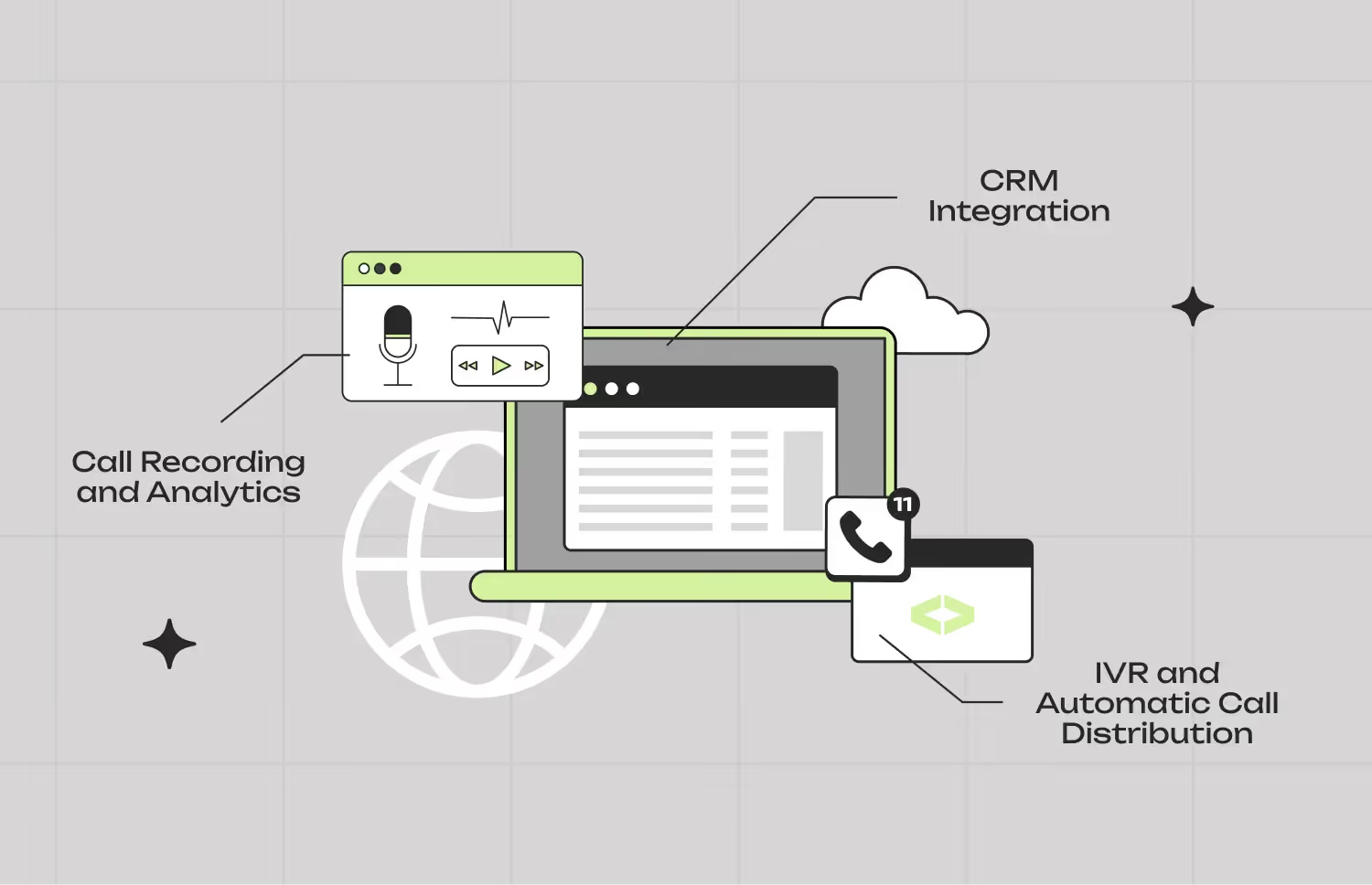
A virtual PBX does not just affect call handling itself, but the speed of response and process control. These factors determine how many leads reach managers and how quickly they are processed.
The IVR system removes unnecessary steps at the entry stage. The customer is immediately directed to the right department or manager without manual transfer.
Automatic distribution balances the load:
With inbound traffic of 200+ calls per day, even a delay of 5–10 seconds impacts conversion. Some customers simply do not wait for an answer.
Call recording is not for formal control, but for improving results.
In practice, analytics is used to:
Without this data, sales management is based on assumptions rather than facts.
Without integration, calls and CRM operate separately. Some data is lost, and some is entered manually.
Integration solves this at the process level:
As a result, lead processing time decreases and errors from manual data entry are reduced.
“CRM integration often looks like a technical improvement, but its impact quickly becomes operational.
Without CRM connection, a manager starts each conversation from scratch. This adds 20–40 seconds for clarification and reduces contact quality, especially with high call volume.
After integration, the workflow changes: the call is already linked to the customer, the manager sees the context and moves directly to the point.
As a result, processing time decreases and the number of repeated calls caused by lost information is reduced.”
— Head of Service, DID Global
The impact of a virtual PBX is visible not in the interface, but in metrics. The main change is response speed and control over each call.
In systems without PBX, part of the leads are lost at the entry stage: the customer could not get through, did not wait for a response, or reached the wrong manager. At 200–300 calls per day, this results in 10–20% lost inquiries.
After implementation, the handling logic changes:
This reduces entry losses. The same traffic volume results in more processed contacts and more deals.
In practice, this leads to a 10–25% increase in conversion without increasing acquisition budgets.
Switching to a cloud PBX makes sense when telephony starts limiting team performance.
This is usually visible through specific signals:
Under these conditions, telephony stops being a supporting tool. It begins to directly affect conversion and lead processing speed.
In such cases, a virtual PBX becomes part of the infrastructure that balances load, captures all inquiries, and provides process control.
DID Global builds such systems for real workloads: with inbound traffic control, stable performance during peak hours, and the ability to quickly adjust call handling scenarios.
If calls already exist but some are lost or never reach a conversation, the growth point lies in telephony. This can be fixed without increasing the advertising budget.